
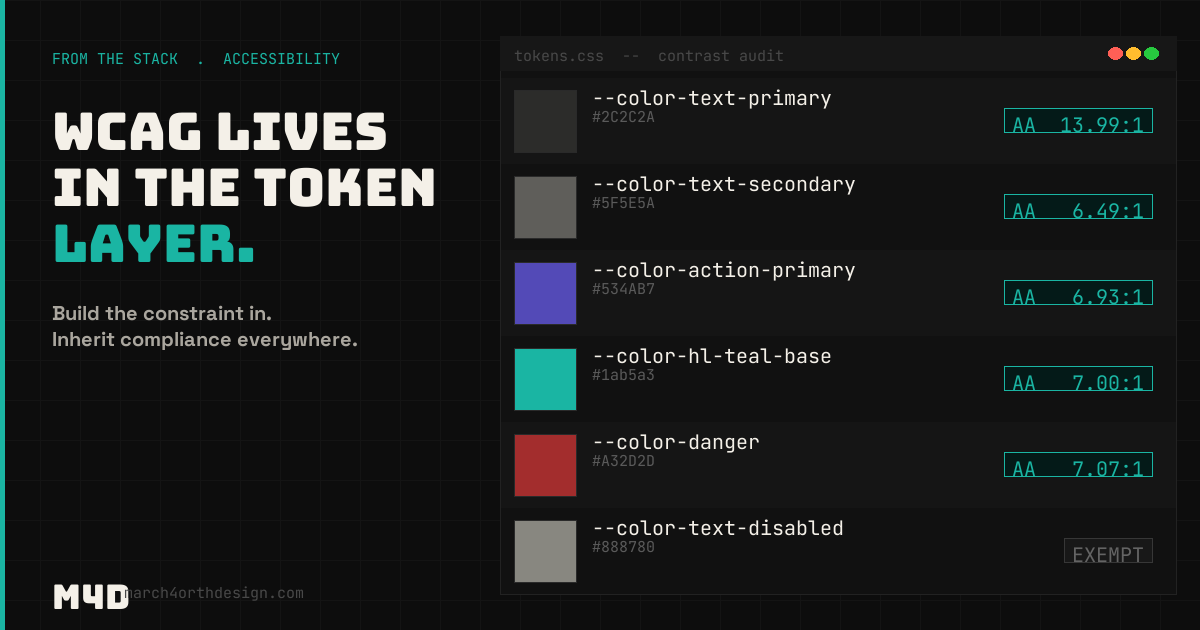
WCAG compliance isn’t a checklist you run at the end — it’s a constraint you build into the system at the token level.
A lot of designers treat accessibility as a QA pass: ship the design, then check the contrast ratios.
That approach fails at scale because it moves the problem downstream where it’s expensive to fix.
The better model is encoding WCAG AA requirements directly into your token architecture — color tokens carry contrast guarantees, semantic tokens enforce them at the component level, and the whole team inherits compliance without thinking about it.
When –color-text-primary is defined as a paper-on-ink value that already clears 4.5:1, every component that uses it is accessible by default. The constraint lives in the system, not in individual designer judgment calls.
For junior designers especially, this is the shift that makes accessibility stick: instead of memorizing contrast ratios, you learn which tokens are approved for which roles, and the system enforces the rest.
Leave a Reply
You must be logged in to post a comment.