
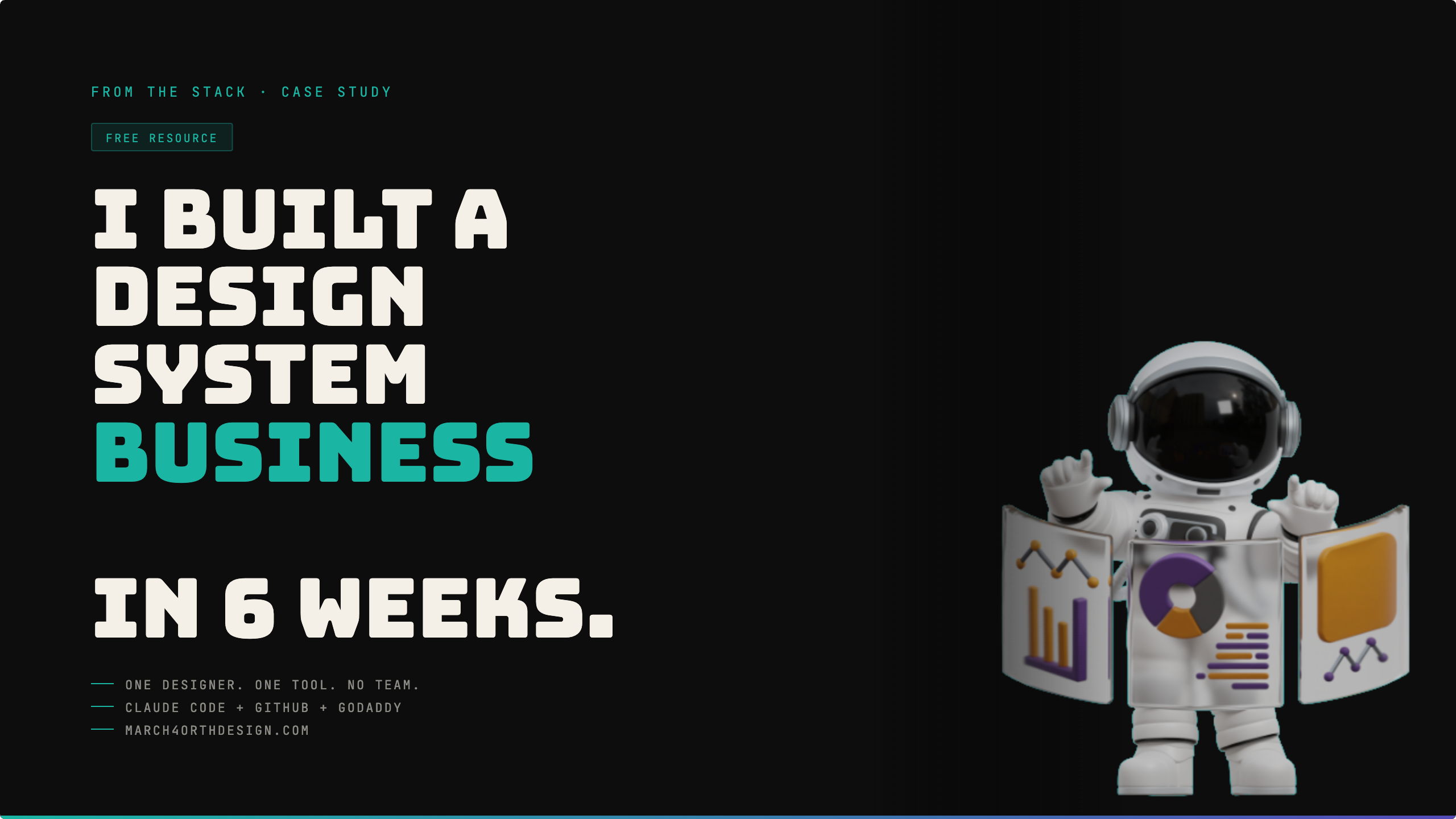

Six weeks from first commit to a deployed product site, a content pipeline, a Gumroad membership, and a MailerLite funnel — one designer, one tool, no team.
On April 25, 2026 I ran git init in a Google Drive folder. On June 5 I had a functioning design system business: a static site deployed to GoDaddy via GitHub Actions, a token architecture shipping as a live CSS file, a membership product live on Gumroad, a free download flow wired to MailerLite, a content queue rotating carousels and reels on Instagram, and a shell script that composites finished MP4 reels from raw video using FFmpeg and Pillow. All of it built inside VSCode with Claude Code. No local dev server. No framework. No team.
This is what you can build on top of the workflow.

Part 1 — The Setup (30 Minutes)
If you haven’t read the Claude Pro Design Workflow Setup guide, start there. It covers the foundation: Google Drive folder structure, GitHub repo, Claude Code CLI, three-tier token architecture, and GitHub Actions FTP deploy to GoDaddy. That’s the 30-minute setup. Everything below is what gets built on top of it.
The single most important decision in that guide is the folder split: non-code assets live in Google Drive, the 05-code/ subfolder mirrors to GitHub exactly. That separation means Claude Code always has a clean, file-aware working directory — no noise, no stale copies, no manual syncing. It sounds like a small thing. It isn’t.

Part 2 — What Gets Built On Top
The static site as a product platform.
The deploy pipeline from the setup guide doesn’t just push a styleguide — it pushes a full product site. Membership page, pricing tiers, download flow, blog, services, portfolio. Every page is a plain HTML file. GitHub Actions FTP-deploys the whole repo on every push to main. No build step, no CMS, no hosting complexity. The token CSS file — tokens.css — ships to a live URL and is importable by anyone in the membership.
The content pipeline.
This is the part that surprised me most. Claude Code doesn’t just write code — it maintains a content queue. A markdown file (queue.md) tracks the rotation: Carousel → Specimen → Reel → Quote → repeat, with three visual pillars (teal/educational, purple/aesthetic, neutral/BTS). Each slot has a skill that generates the full content package: slides, caption, a blog draft. The queue advances. The rotation holds. Twelve pieces produced in six weeks without ever staring at a blank page.
The reel compositor goes further: a shell script (compose-reel.sh) takes a raw video file, generates Pillow PNG overlays with M4D design system typography, and outputs a finished 1080×1920 MP4 using FFmpeg — Bungee headlines, JetBrains Mono labels, token pill, tinted background, floating astronaut. The whole M4D visual language baked into video, from the command line.
The token architecture shipping live.
The three-tier token system from the setup guide — primitives → semantic → CSS — isn’t just a local file. It deploys to projects.march4orthdesign.com on every push. The membership product includes that CSS file as a download. The design system teaches itself through the product that ships it.

Part 3 — What Surprised Me
Claude Code changes the scope of what one person can ship. Not because it writes perfect code on the first try — it doesn’t. Because it holds the whole repo in context. It knows which files reference which tokens. It catches the nav link you forgot to update in seven files. It remembers the WCAG contrast rules and applies them without being asked twice. The bottleneck stops being “can I build this” and becomes “what should I build next.”
No local dev environment forced cleaner decisions. Every change deploys to a live URL. There’s no sandbox to hide messy intermediate states. That constraint pushed toward simpler HTML, flatter file structures, and token-based CSS that doesn’t depend on a build tool to be readable. The discipline came from the limitation.
The content pipeline is the product. The Instagram channel, the carousels, the reels — they’re not marketing for the design system. They are the design system, made visible. Every piece of content is a worked example of the token architecture, the type stack, the spacing system. The audience learns the system by watching it get used. That feedback loop is the most powerful thing in the whole setup.
Start Here
The Claude Pro Design Workflow Setup guide is free. It gets you from zero to a deployed token system in 30 minutes. When you’re ready to go further — the full Design Stack, the content pipeline, the membership architecture — that’s what The Design Stack is for.
Leave a Reply
You must be logged in to post a comment.